The Lord God took the man and put him in the Garden of Eden to work it and take care of it. — Genesis 2:15
They Say Crazy Things Are Coming
There’s a low buzz under the news — the sense that something big is happening and we’re not ready.
A restructuring is coming, they say. It’ll happen gradually as AI and robotics eliminate jobs.
Is a non-working society going to liberate humanity from toil (the Musk mentality), or trigger an existential crisis (the Hawking mentality)?
If you’re in the Hawking camp, consider this: the threat may only be a threat to the extent that it feeds on a human belief system. I call that belief system The Assumption.
I want to talk about AI and robots — and I want to talk about God, the creator of the human soul. Yes, a conversation about God and AI makes sense now more than ever before.
These are my thoughts — what I think is coming, what I’ve been reading, and the mental space I keep finding myself in while I work through it.
The Assumption: What It Is, How It Works
What I’m calling “The Assumption” is the belief that there is Group A — the important people, the producers — and there is Group B, everyone else. Group B isn’t important or capable enough to create anything that matters, so they have very little to offer the world. They simply consume what Group A creates. Group B is the 99%.
Is that really so bad? There are over 8 billion people on this planet. Is it a tragedy to be one of the 7.92 billion whose impact is limited to whatever value a job assigns to them?
I’d argue YES — it is bad.
It was bad before AI. It’s going to be way worse because of AI.
Before AI, the thought of being inconsequential scared me. Yet so many people seem to accept their plight as members of Group B. To me, the worst part is what comes after accepting it — we stop living for anything other than leisure and comfort. No purpose. No contribution. No striving to give the world anything. Just make us comfortable while we wait to die.
But after AI changes the world forever, being in Group B won’t just be sad. It will be an existential threat. At least before, you could get a job, provide for yourself, and find some small sense of purpose in it. But when machines do all those jobs, what do we have left?
We have no choice but to get out of Group B. It matters for our joy, our mental health, and maybe even our survival.
But how do we do it?
We only become members of Group A by recognizing it doesn’t exist. Everyone has something great to give the world.
And the very thing that threatens us is the same tool that can help liberate us.
AI is like every powerful thing before it: it isn’t humanity’s solution. But it can point to the solution.
I’m going to talk about how you can use AI to reach your full potential later. But I am not claiming AI will transform you into what God made you to be. It can help you see that your limitations are only in your mind, see what you’re capable of, and the only question worth asking becomes: what has God created me to work on?
Arriving at that question is one of the best things that can ever happen to a person. Would you rather think about how an organization sees you, or how the God of the universe wants to use you? I’ll take the second one.
I’ve heard some great speeches, read a few great books, sat in some good peer groups, attended some amazing conferences, been inspired by brilliant people, and had ideas I was genuinely excited about. All of it kept me believing I could do something meaningful. I never gave up on the question — am I really stuck where I think I’m stuck? I believed the Assumption, but I knew which group I wanted to be in.
If you’re reading this, maybe some part of you is asking the same question. Don’t waste it. The fact that you’re still asking is evidence you’re not who The Assumption says you are.
A massive lever
Those inspiring experiences I mentioned above can’t compare to what I felt when I discovered how AI can shrink the time from idea to implementation to mere minutes. It was exhilarating to learn my best ideas to date were tiny compared to the ones still buried in the corridors of my mind.
My inability to unlock them wasn’t because AI hadn’t arrived yet. It was because I doubted myself. The Assumption intended to plant me firmly in Group B and keep me there.
AI doesn’t care if you’re famous. It doesn’t care if you think you’re nobody. It takes whatever ideas you put in front of it and weighs them against the possibilities — nothing more. It isn’t colored by what others think of you, by your past failures, or by how deep The Assumption has its teeth in you. If you’re someone who often dismisses your ideas before they ever make it out of your head, this alone is a quiet kind of freedom.
Even though I deny the validity of The Assumption, no one can deny its framework is effective. From the standpoint of living with intent and purpose, I’d say most of humanity is deactivated. Producers aren’t better humans. They’re just activated because they aren’t limited in their beliefs about what they can actually do.
Like Group A, Group B doesn’t exist. It’s a made-up thing, and the only reason it seems real is because so many people believe it.
If The Assumption is false, what is the truth? The truth is that no matter who you are, God has placed inside you the ability to create things that are useful in this world. And here’s the most exciting part: no one else can do it the way you can. Whatever you create, you’re the one who has to do it. If anyone else does it, it won’t be what it was going to be if you had done it.
“What do I have to offer the world?” Only you can answer that. But you could dig deep and identify your passions if you wanted to. Here’s an example you might be able to apply to yourself in some way.
The Grandmother
Picture a grandmother who teaches her grandchildren how to bake bread from scratch. She works a clerical job where she has faithfully reported for duty for 29 years, but she doesn’t have enough to retire. The company she works for is starting to pick up on the fact that AI can do her entire job.
Grandma’s in trouble.
Pre-AI: she has meaning (she’s activated, she’s giving) but no provision (she’s not making a living from her gift). Once her job is taken from her, she loses her livelihood and her reach. She’ll still have that reach with her three grandkids. A beautiful picture, but very limited.
Now bring AI into her life. She writes the cookbook with AI editing and illustrating. AI builds her website. AI edits the YouTube series and writes the captions. She teaches a hundred thousand other grandmothers. Same gift. Same heart. Now she has meaning, provision, and a reach of a hundred thousand. And that capability was always inside her. She always had something huge to give. She always possessed the power to enrich other lives. But now the barriers are removed, and she can activate it.
Pre-AI, The Assumption had economic teeth. You could believe “I’m not a producer” because the system made individual production economically marginal. You needed a publisher, a label, a distributor, capital, technical staff, a marketing budget. The 99% genuinely couldn’t access provision through their gifts — the gatekeepers stood in the way. The Assumption had an alibi: “yes, you have a gift, but you can’t make a living from it.”
AI dissolves the gatekeepers. The publisher, the editor, the developer, the designer, the marketer, the distributor — all of them now run inside a tool anyone can use, no technical skill required. Whatever you love and are good at can now provide for you in a way it never could before.
The Assumption used to have an excuse. It doesn’t anymore. The Assumption is humanity’s most limiting framework because it’s a belief that has outlived the conditions that made it necessary. It used to be partly true for economic reasons. Now those reasons are gone, and the only thing keeping people in Group B is that they still believe it.
So it doesn’t matter how small your ideas seem to you. It doesn’t matter how little value you’ve placed on your own contributions. The tool that threatens the negative-thinker is the same tool that can draw out what’s already inside you. That can change your life.
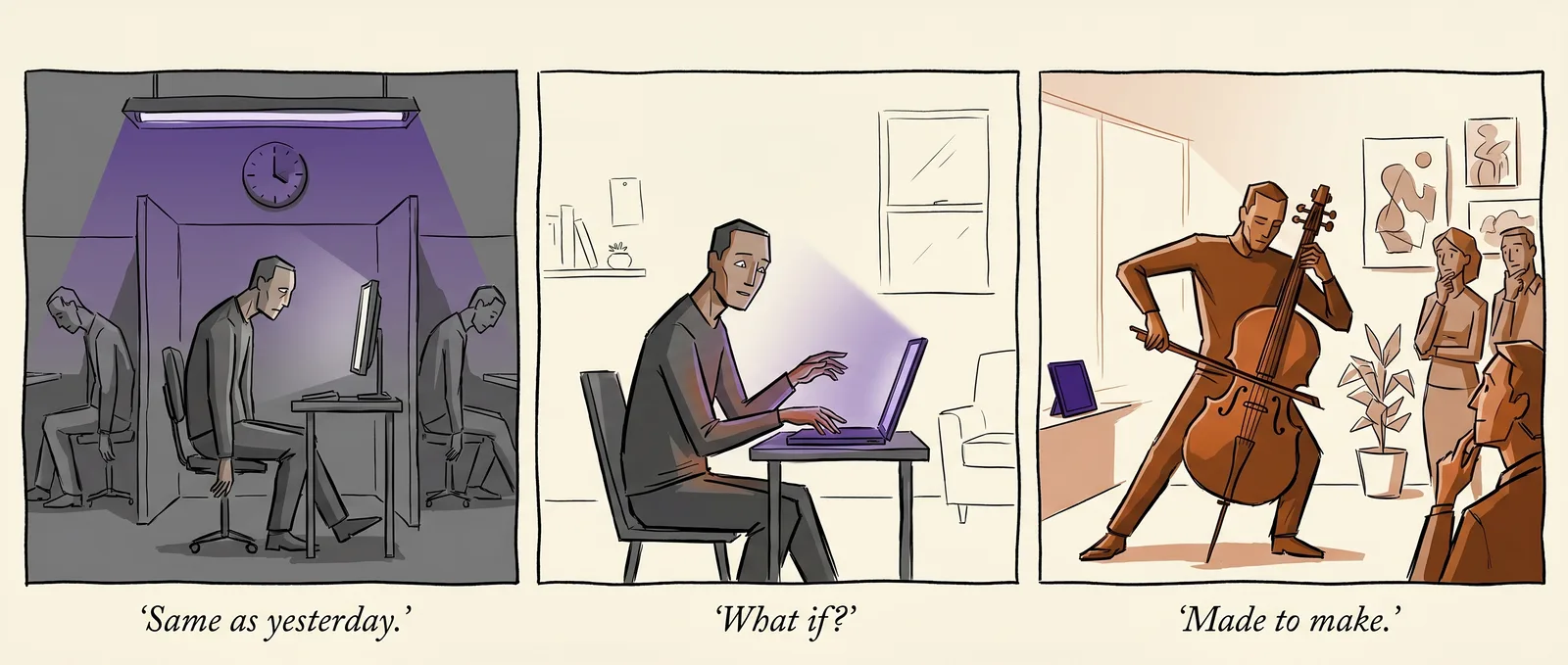
Maybe your thing is a symphony you want to compose. Maybe yours is a recipe, like the grandmother’s. Maybe yours is the wisdom you’ve been giving away at your shop for the last thirty years. AI doesn’t care which one is you. It just removes the wall that propped up The Assumption.
How could The Assumption possibly be false?
You might say, “I don’t know, Joe. When I look at the world, The Assumption does seem to be true. We all know who Elon Musk is, but I’ve never heard of you. Seems like a Group B situation to me.”
I hear you. The world certainly appears to operate as if The Assumption is true — that there are important people and not-so-important people.
So if The Assumption is false, why are 99% of us deactivated?
Here’s my take, and it’s simple. People are not deactivated because The Assumption is true. They’re deactivated because they believe it’s true. The Assumption is humanity’s most limiting framework because it doesn’t have to be true to control how humans live. Our belief in it is what activates its effects.
Think of money. The only reason money works is that we all accept and believe it has value. If everyone stopped believing, we’d stop accepting it as payment. The Assumption operates the same way. We believe we aren’t in the important group, so we remain deactivated.
Jesus told a story that names this exactly. A master gives three servants different amounts of talent — money, in the original — and goes away. Two invest theirs and double them. The third buries his in the ground. When the master returns, the third servant says: “I knew you to be a hard man… and I was afraid, and went and hid your talent in the ground.” He buried what he was given because he believed three things: that he was small, that the task was risky, and that the master was cruel. The master’s response is severe — he calls the servant wicked, takes back the talent, and casts him out.
The judgment is not about the size of the gift. It’s about what the servant believed about himself, his task, and his master. The deactivated 99% are the third servant. The Assumption is what he buried his talent under.
Two thousand years later — where we are now — the master still provides talents. AI is arguably the largest expansion of capability humanity has ever been handed. Are we going to invest it, or will we bury it? Will we hide from it in fear, or will we recognize the opportunity?
What if the government just pays everyone?
Whenever we hear about AI and robotics replacing people, the conversation turns to how those people will survive economically. The idea: machines will take all the jobs, so we’ll need government programs that send regular, unconditional cash payments to every citizen — regardless of income, employment, or contribution to society.
There are two approaches.
Universal Basic Income (UBI)
You can read countless pages on UBI elsewhere, but simply stated: UBI would guarantee basic economic security for everyone. Think of UBI as the floor — it keeps people from starving while they figure out what to do.
UBI aims to reduce poverty and inequality, but critics are concerned.
It’s expensive — very expensive. Some proposals estimate trillions of dollars in cost, which would balloon the national debt and require significant tax hikes.
Others worry that unconditional money would shrink labor force participation. Imagine that effect in an already-stressed job market where automation has taken almost everything. Not good.
My deeper problem with UBI comes from the biblical parallels I see in it. From a Christian frame, my mind goes to the manna in Exodus — daily provision with the expectation that you keep working out your purpose. That part is fantastic. The problem is who is doing the providing. God giving His chosen people exactly what they need every day is one thing. World governments making daily provisions is another thing entirely. We’ve never seen that experiment go well in any human society.
Take the Roman bread dole. The state provided grain to Roman citizens — what began as a poverty measure expanded into an entitlement for hundreds of thousands. The poet Juvenal coined the phrase “bread and circuses” (panem et circenses) to mock how the dole degraded civic engagement. People stopped voting, serving, or contributing because they were being fed. The pattern outlived the empire.
How about the Soviet Union? The state controlled food and consumer goods. Despite massive agricultural capacity, the result was chronic shortages, hours-long bread lines, and rationing that lasted into the 1980s. The lesson: when the state owns supply, supply becomes a political instrument instead of an economic one.
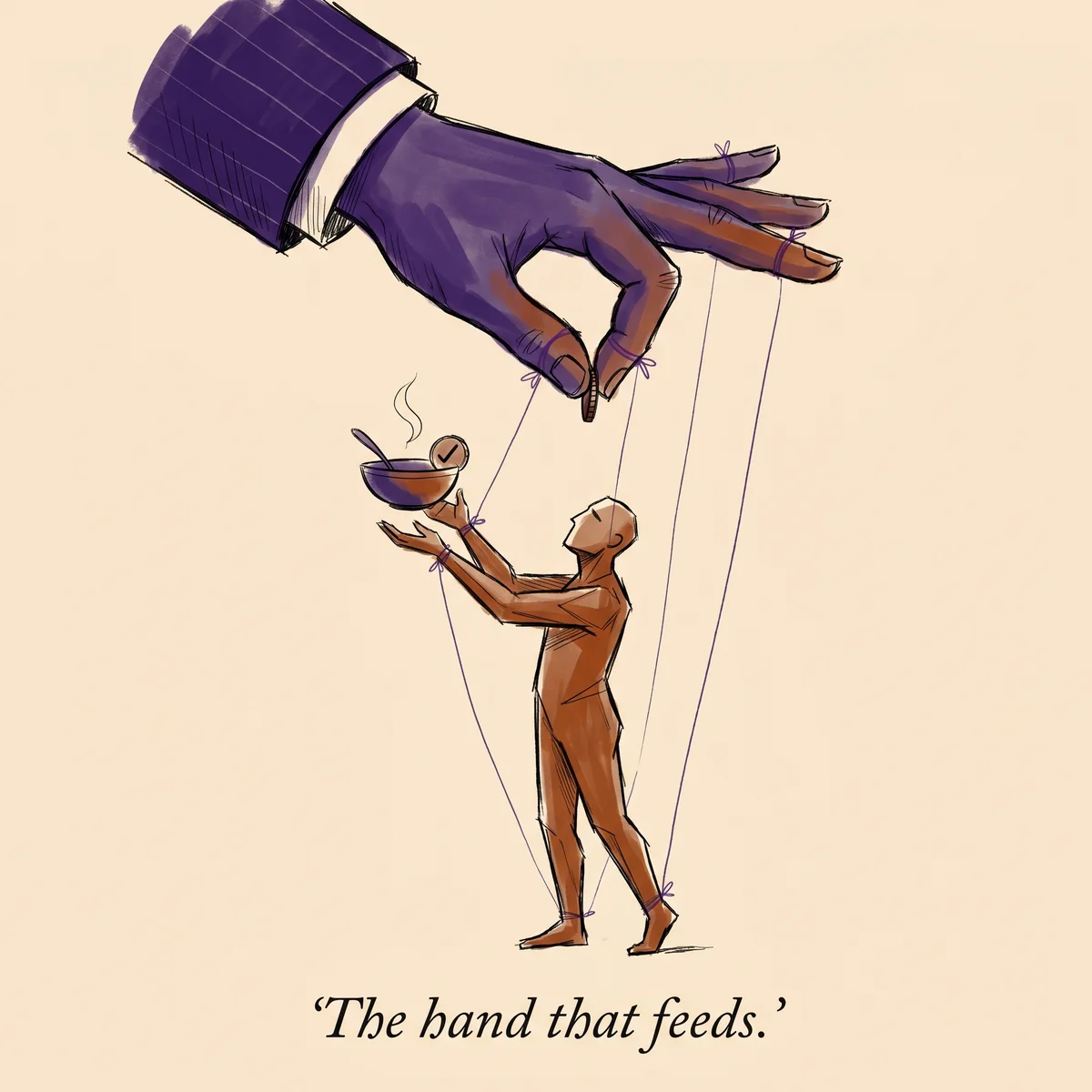
And those are just the headline cases. Mao’s Great Leap Forward in the late 1950s and early 1960s. North Korea’s Public Distribution System, which collapsed into a famine that killed somewhere between 600,000 and 2.5 million people. Venezuela’s CLAP boxes, where hyperinflation gutted the currency, food production collapsed, and the boxes became politically conditional — vote correctly and we’ll let you eat. That last one explains why 7 million Venezuelans have fled the country. Even Britain’s post-war rationing (1945–1954), less dramatic but instructive, shows how wartime rationing extended into peacetime and actually tightened in some categories.
The pattern holds across regimes: once the state takes over a category of provision, even democracies struggle to give it back.
Someone will counter that the Nordic countries have made it work. But notice the difference: Norway, Sweden, and Denmark provide a floor (healthcare, education, unemployment bridge) inside an otherwise robust market economy where most people still work. They haven’t eliminated the mandate. The Nordic models actually support the UBI-vs-UHI distinction I’m about to draw.
Universal High Income (UHI)
“Okay, Joe — so you’re saying UBI is bad. What else is there?”
There’s another response. In fact, the X post below is what got me started writing this article.
Just days ago, Elon Musk posted something that has people excited. He’s basically saying: forget UBI — let’s talk about UHI, Universal High Income.
Universal HIGH INCOME via checks issued by the Federal government is the best way to deal with unemployment caused by AI.
UHI isn’t just a different proposal — it assumes circumstances that would be unrecognizable to the world we know now. The concept only works if Musk’s prediction holds: that AI and robotics will create such immense abundance that governments can hand high incomes to everyone.
Unlike UBI, which only covers necessities, UHI provides widespread prosperity in a world where goods are abundant. In other words, the need for traditional work would be completely erased.
Let’s compare the two
Both proposals assume a situation of unprecedented abundance ushered in by AI. But the thinking behind them is very different. Here’s a table to help visualize the gap.
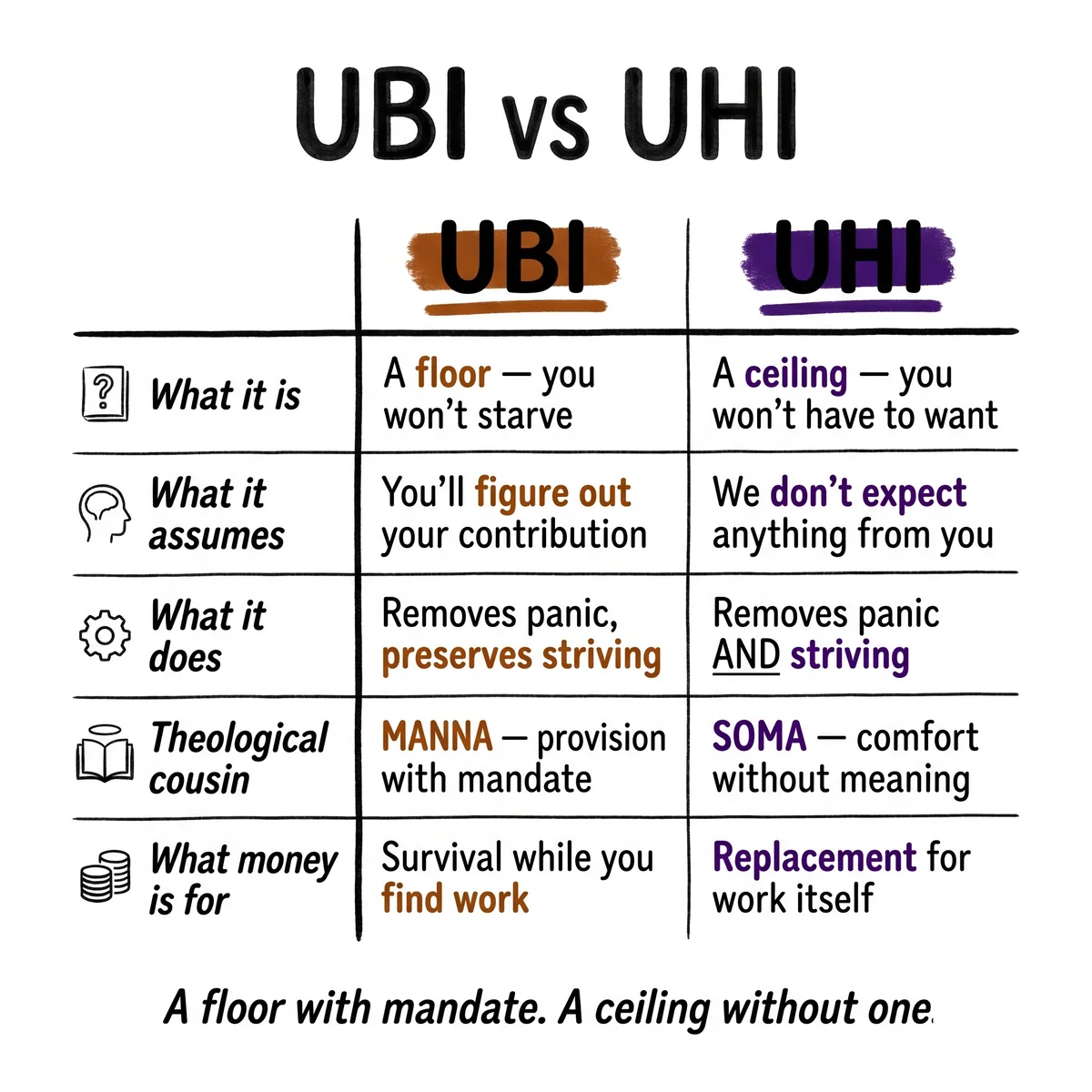
UBI says, “you won’t starve while you figure out who you are.” UHI says, “we don’t expect you to figure anything out — here’s enough money to keep you docile.” UHI is what The Assumption looks like when it gets a budget line.
What if the problem is just bad jobs?
There are two schools of thought here.
- Humans are deactivated because of The Assumption (my take).
- Humans are not deactivated at all — they’re just disengaged because their jobs are dehumanizing.
The second view says the disengagement is organizational, not anthropological. That’s why people do meaningful things on the weekends — with their kids, in their churches, on vacations, any time they’re not at work. The idea: people are activated except between Monday and Friday, 9 to 5.
By that logic, both UBI and UHI look like solutions, because both liberate humans from work and toil. UBI frees people to do what they’d rather be doing. UHI goes one better — people don’t have to do anything at all.
Carried to its logical end, that view ends up calling the result a kind of paradise — work obsolete, scarcity gone, every human comfortable forever. We’ll come back to that picture in a minute, because I think it’s hiding a deception.
But I think the problem is the whole person, not just their work life. Removing jobs won’t fix it — it will make it worse. At work, at least, we’re in a forced container for some kind of contribution.
Yes, much of the workplace misery people face is just bad management. But take that away — give them the perfect remote job — and most still feel like spectators in their own lives. The deactivation goes deeper than the cubicle.
So the problem is not bad bosses. It’s a lack of purpose at the spiritual level.
UBI is the better of the two ideas. At least with UBI, people still need to figure out who they are and what they’re for, so they can find a way to contribute something the world will pay them for.
If you like UHI, you’re probably subscribed to a thought frame where humanity’s goal is to become prosperous, comfortable, and free from the bonds of toil. But I think we have a biblical mandate for a much higher calling than that.
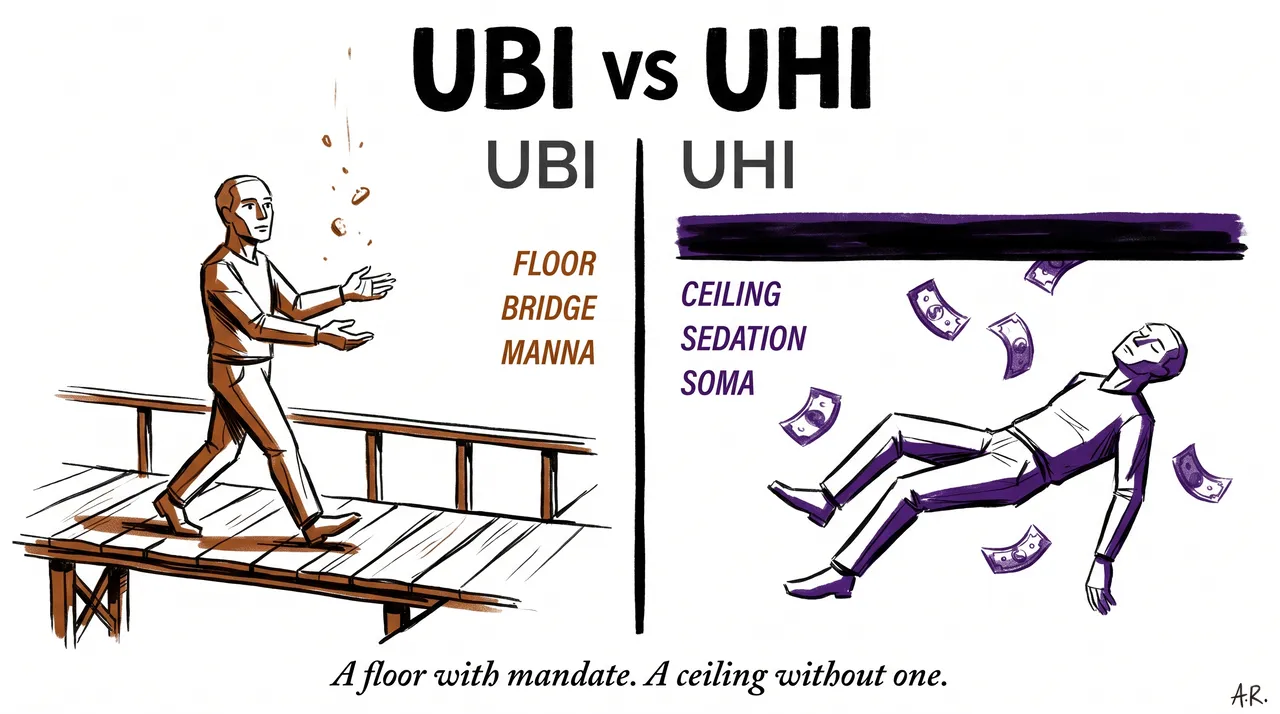
Work was always the plan — the mandate came before the curse
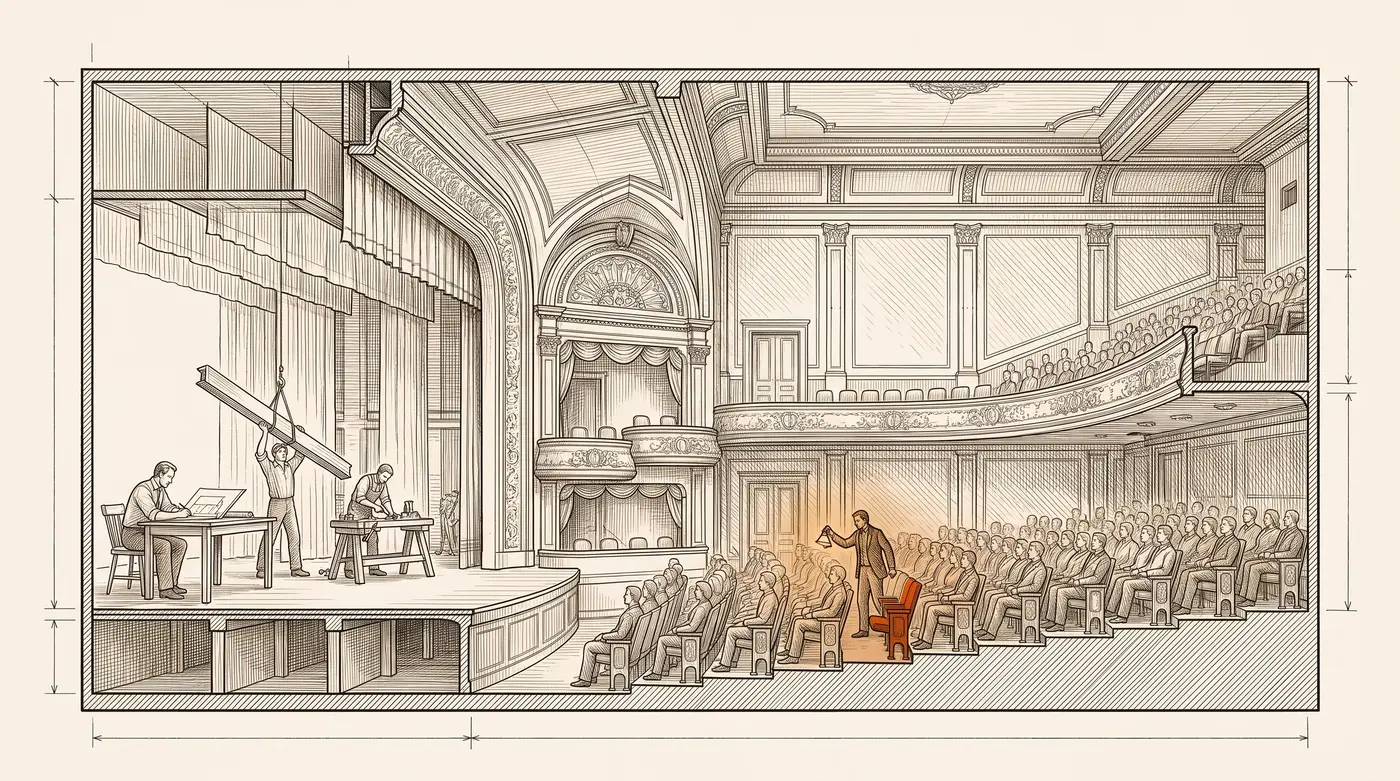
Remember that paradise picture from a moment ago? Work obsolete, every human comfortable forever, scarcity behind us? Notice what’s happened. They’ve called it Edenic, and Eden HAD work. The first humans were placed in the garden specifically to work it and keep it — that’s the line at the very top of this article. What they’re describing isn’t Eden. It’s an attempt to recreate Eden by removing the very thing God placed inside it. That’s not paradise. It’s a counterfeit.
So if Eden’s design is the standard, what was that design actually for?
Genesis tells us God placed humans in the Garden of Eden, but not to hang out and enjoy the scenery. They were placed there to “work it and keep it.” They were caring for the garden. Cultivating it. Protecting it.
We’re also told that humans were created in God’s image. God worked to create the world, then He rested. We follow that rhythm — work and rest — exercising stewardship over what He made.
Many people believe we only work because of the Fall. But Imago Dei — the doctrine that humans are made in God’s image, originating in Genesis 1:27 — predates the Fall. It’s where we derive our inherent dignity, value, and divine representation. Imago Dei is far more than inheriting God’s symbolic traits. It’s humans existing after the pattern in which God exists.
Being made in God’s image brings tremendous beauty into view about what it means to be human. We’re made to mirror God’s character. We’re made to serve as stewards of creation. We reflect God through creative effort, intellect, and a spiritual, moral, and rational structure.
This is exactly why The Assumption is the most limiting framework humans have ever lived under. It doesn’t just tell you that you’re not important — it tells you that the image of God in you is for somebody else. That God’s creative pattern got handed out to a small group of “real” creators and you got skipped. The Assumption is not just incorrect about you. It’s incorrect about God.
What I really want you to know
I started this with that low buzz under the news. Maybe you’ve felt it. Maybe you haven’t. Either way, here’s what I want to leave you with.
AI is not going to make you who God made you to be. Only you can do that. But AI is the loudest invitation you have ever been given to stop hiding the talent you buried.
The world that’s coming will have less use than ever for people who have decided they’re nobody. And it will reward — wildly — anyone who is willing to do the real work of becoming who they already are. That’s more possible now than it has ever been.
Group A doesn’t exist. Group B doesn’t exist. There’s just you, the talent your Master gave you, and what you decide to do with it before He comes again.
About Joe

I run an IT and Cybersecurity company that helps businesses strengthen and adapt their security postures while keeping system uptime optimal. Off the clock I’m a pianist, a Bible student, a husband, and a dad. I write to think out loud — mostly about technology, faith, and the places the two keep bumping into each other.